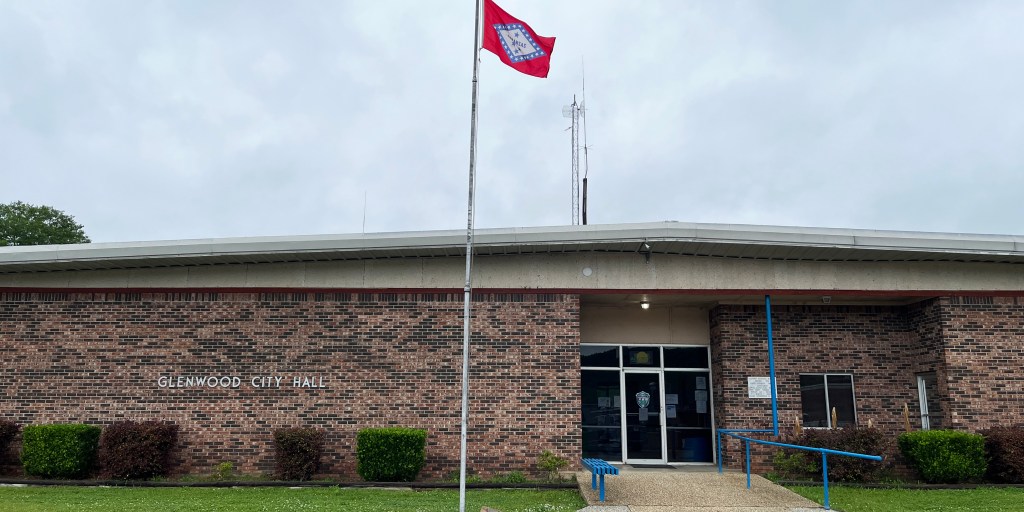
The Arkansas Economic Development Commission is facilitating a nearly $500,000 grant to cover the full cost of installing an ultraviolet light at Glenwood’s wastewater treatment plant. A ceremony to sign the paperwork is scheduled for Tuesday, June 30, 1 p.m. at City Hall. A representative of the AEDC will be there to explain the process and answer any questions.
The city currently uses chlorine to disinfect sewage, which creates carcinogenic byproducts that are harmful to aquatic life when wastewater is discharged into a creek that flows into the Caddo River, then DeGray Lake and eventually the Ouachita River.
UV lights are considered superior to chlorine because it is a chemical-free process that instantly neutralizes pathogens.
“It’s going to be a big deal for the city,” said Mayor Billy Plyler. “Hopefully we can supplant some of the violations we’re in.”
The Arkansas Division of Environmental Quality and the Arkansas Department of Health have repeatedly warned the city in recent years about problems with its sewage system which have sometimes caused untreated sewage to be released.
The installation of a UV lamp is one of several projects the city is involved in to rectify those issues. Last month, work began on a $4 million project to dig up and replace crumbling sewer pipes throughout the city.
Glenwood applied for the grant to cover the cost of the UV light almost three years ago, Plyler said, and qualified as a low-to-moderate income (LMI) city based on the 2020 census. The designation is used by governments and financial institutions to target economic support, infrastructure funding and community development. The grant will include the expense of required engineering studies and the work of a grant writer, Plyler said.
According to the Environmental Protection Agency, a UV disinfection system transfers electromagnetic energy from a mercury arc lamp to an organism’s genetic material. When UV radiation penetrates the cell wall of an organism, it destroys the cell’s ability to reproduce. The process happens in a matter of seconds.
The UV treatment requires less physical space for holding wastewater. It also eliminates the handling, storage and transportation of dangerous chemicals like chlorine, making it safer for plant employees and people in the vicinity.
The downsides are that a UV light cannot penetrate cloudy water, so wastewater must be heavily filtered before reaching the lamp. Because there is no disinfectant residue as there would be with chlorine, it only treats wastewater passing the light at that exact moment. A UV system also needs a continuous power supply, perhaps with a generator for outages, to keep functioning.
A post on the city’s Facebook page said: “This grant represents an important investment in Glenwood’s infrastructure and will support improvements to our wastewater treatment system through the use of ultraviolet disinfection technology. We invite community members to join us as we celebrate this exciting step forward for our city. We look forward to recognizing the partnerships and hard work that made this opportunity possible.”
Repairing Glenwood’s aging infrastructure has been a priority for the mayor. Once funding for the UV project is received, Plyler said the city can apply for an additional grant for a separate project as a qualified LMI city.
“We’d be crazy not to,” he said.
Plyler said he doesn’t know yet what project that funding might go towards.
“We’ll have to look at that with the grant writer and the city council,” he said. “We’re not far enough along yet to know. We’ve got some other projects we need to look at, but I don’t know what qualifies.”