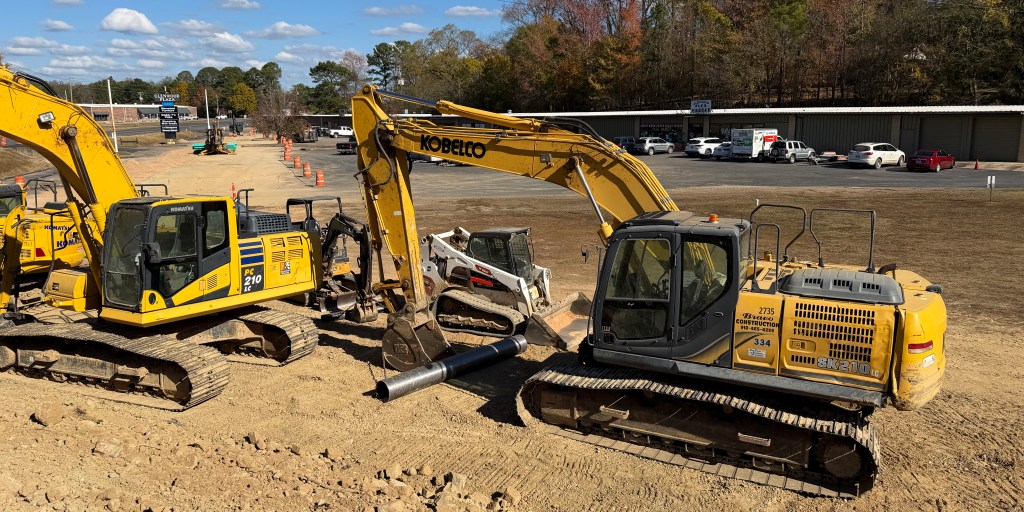
Photo caption: Heavy equipment used in Glenwood’s sewer line replacement project sits idle Friday, Nov. 20, as orange cones block part of the parking lot at Glenwood Plaza along U.S. 70.
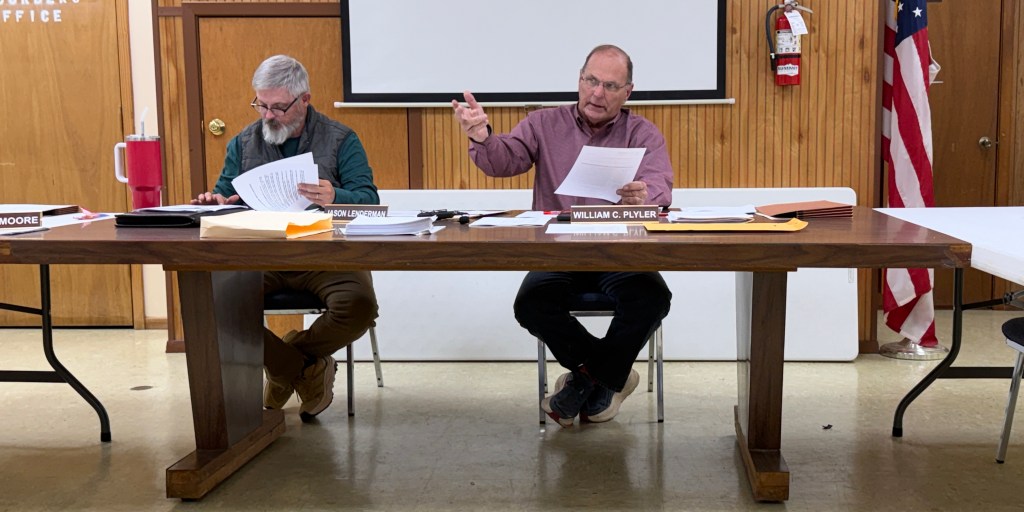
As heavy equipment is being used to dig trenches throughout Glenwood to replace deteriorating sewer lines, mounting complaints about damage to private property led to a heated exchange between Mayor Billy Plyler and City Council member Alan Moore during the council’s meeting Tuesday, Nov. 17.
Moore criticized the way the multimillion-dollar project is being carried out, citing a lack of communication with residents. He said he has received numerous complaints from property owners whose yards, driveways and fences have been damaged by construction crews.
Moore suggested the contractor should have someone visit property owners before construction begins, explain what work will be performed, document existing conditions and provide contact information.
“Is it too hard to have a good contact man on the ground before a job, after a job, informing constituents and following up with quality control,” Moore asked. “This thing’s going south and it’s going south fast.”
Plyler defended the contractor and the city’s oversight of the project, repeatedly assuring Moore and other residents that damaged property would be repaired. He said much of the restoration work cannot be completed until rainfall allows disturbed soil to settle.
Moore described problems at commercial properties he owns, saying construction equipment and materials had blocked entrances for weeks, while rocks and debris were left behind.
Plyler pushed back, raising his voice.
“I don’t know of any driveway that they have left that they were not working on that you couldn’t pass that day, Alan. You’re saying something that is not true,” Plyler said. “They’ve got to have the ditch open long enough to get the pipe in.”
Moore said workers removed signs at two of his properties despite assurances they would not be disturbed. One was later reinstalled improperly. He also said a natural gas line was damaged at one location, costing him $2,400 to have service restored.
Plyler told Moore to provide documentation of the expense.
“If you paid $2,400 to turn on the gas line, I need the bill. The contractor will take care of that because he tore the line out,” Plyler said. “I’ll get it taken care of.”
Moore cited complaints from other property owners, including an elderly couple who he said spent days removing rocks left behind by construction crews. He questioned how residents with limited financial resources or physical disabilities could deal with such damage.
“This contractor has finished nothing because he can’t,” Plyler said, explaining that a lack of rainfall has prevented the soil from settling sufficiently for permanent repairs.
“He’s gonna put the drive back in. He’s gonna put the topsoil back down. He’s gonna seed the grass,” Plyler said.
The contractor may have to return to some locations three or four times, Plyler said, before properties can be restored to their previous condition.
He noted the city is operating under an administrative order from the Arkansas Department of Energy and Environment’s Division of Environmental Quality requiring improvements to its deteriorating sewer system.
“We’re not replacing these sewer lines because we want to,” Plyler said. “We have no choice.”
The city’s wastewater treatment plant is designed to handle approximately 450,000 gallons per day, Plyler said, but during heavy rainfall the system can receive as much as 3 million gallons because of water entering deteriorated sewer lines.
Plyler acknowledged disruptions near the Fish Nest restaurant, saying the Health Department had contacted him about conditions there and that the work had to proceed.
“Is it an inconvenience? You bet it is, and I’m sorry about it,” Plyler said.
Disagreement over oversight
Moore also questioned who is responsible for inspecting the work and verifying that the city is getting the amount of pipe installation for which it is billed.
Council member Jimmy Clark said he had personally observed an inspector monitoring construction and maintaining records. Plyler said the inspector works with A.L. Franks Engineering, the firm overseeing the project, and maintains a daily log used to verify the contractor’s payment requests.
The disagreement became more personal when Plyler reminded Moore that overseeing the project was the responsibility of the mayor, not the council. Moore said he had requested to have a lunch meeting with the contractor which didn’t happen.
“It is my job as mayor to do the day-to-day operation of this town. Period,” Plyler said. “We’ve got too many chiefs out there.”
Plyler, who suffered a heart attack in August, said he had remained in contact with those overseeing construction even while hospitalized and during his recovery. He encouraged residents with complaints to contact him directly.
Moore insisted he was not attempting to take over management of the project.
“Right now we have no communication, and we have no education,” Moore said. “People don’t know what’s happening.”
He expressed concern that the contractor might finish the project and leave Glenwood with unresolved property damage.
“Alan, that’s not gonna happen because that’s not the way A.L. Franks Engineering runs his jobs,” Plyler said.
The mayor said the city is withholding a portion of the contractor’s payments as protection against unfinished work.
Residents describe additional damage
Other residents attending the meeting also voiced concerns, including Vic Forga, who described the loss of a tree that held considerable sentimental value for him and his wife.
“When me and my wife, 40 years ago bought the place, we put a six-foot black cherry tree out right on the property line and it was close to their stuff,” Forga said.
He approached the contractor as work was beginning
“I asked him, ‘Are you going to have to cut that tree?’ I told him, you know, it’s kind of special to us. He said, ‘No, we’ll bore under it.’ I come in the next day and it’s laying on the ground. I thought, well, you know, there ain’t nothing I can do about that now.”
Forga also said heavy equipment had damaged his driveway beyond the area excavated for the sewer line. He said he wanted to be present when repairs were made to ensure the driveway was properly restored.
Plyler said the contractor was expected to have photographs documenting conditions before construction and would be responsible for damage caused by the work. He said he would review the complaints with the engineering firm.
Despite their disagreements, Moore told Plyler he trusted the mayor’s assurances that repairs would eventually be made.
“Billy, you’ve never lied to me one time in your life that I know of,” Moore said. “And if you tell me my driveways are gonna be fixed, I believe you.”
Plyler responded that the contractor would be held accountable.
“We’re gonna hold his feet to the fire on that, and he will do it,” he said.
Moore maintained that his primary concern was preventing additional problems as construction continues by better informing residents about upcoming work and providing them with someone to contact when problems arise.