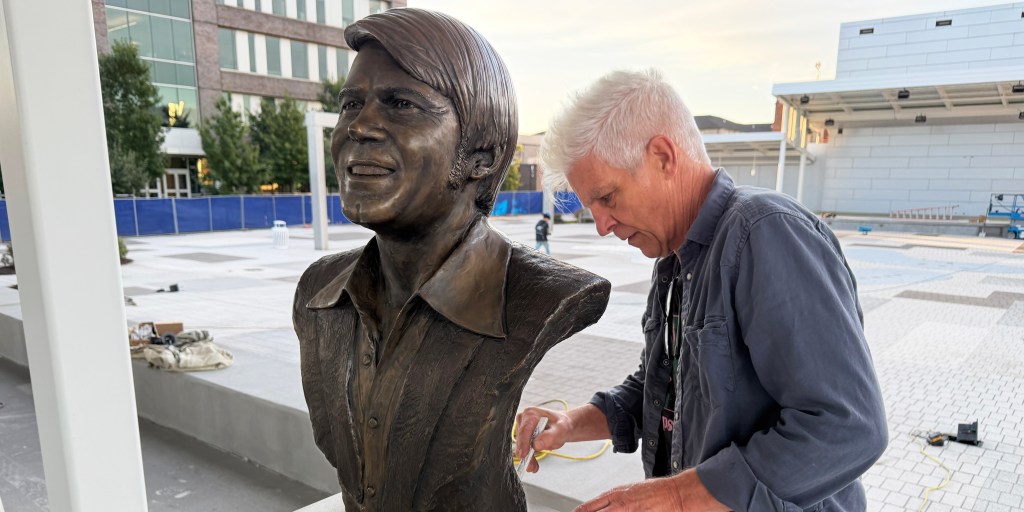
Photo caption: Sculptor Kevin Kresse positions a bust of Pike County native Glen Campbell at the atg Pavilion in North Little Rock. An identical bust is planned for display at the Delight Branch Library. Photo: Michael Hibblen
Glen Campbell, who grew up in Pike County before becoming one of the biggest stars in country and pop music, is among Arkansas musicians being honored at a new pavilion in North Little Rock that celebrates the state’s musical heritage.
A grand opening ceremony was held Friday, Oct. 30, for the approximately $3 million pavilion, which will eventually feature sculptures honoring 20 musicians and a music industry executive whose work helped shape American music.
Campbell was born in the unincorporated Pike County community of Billstown and is buried in his family’s cemetery there. He is more widely associated with nearby Delight, where he attended school before beginning a career that brought him international fame.
He had a string of hits in the 1960s and ’70s and hosted the CBS television program “The Glen Campbell Goodtime Hour” from 1969 to 1972. He brought attention to his hometown by closing the show with the words, “If you’re ever in Delight, Arkansas, come see me.”
A bronze bust of Campbell was installed Tuesday, Oct. 27, three days before the the ceremony at the new atg Pavilion, along with busts of Al Green, Levon Helm, Louis Jordan, Florence Price and Sister Rosetta Tharpe. An 8-foot-tall statue of Johnny Cash, identical to one installed at the U.S. Capitol in 2024, is also be on display.
All seven sculptures were created by Little Rock artist Kevin Kresse, who said Campbell’s bust presented a challenge in how to depict him.
“I started him off, and I sculpted him with just a serious look on his face. And I just went, ‘It just doesn’t feel like him,’ ’cause he was always smiling,” Kresse said.
“So that was one of those where you start and you just go, ‘No, [it’s] just not hitting me right,’ tear it down and start over.”
Kresse ultimately chose to depict Campbell as he appeared during his television years, with the familiar smile audiences associated with the singer and guitarist.
He also sought guidance from members of Campbell’s family, including two of his sisters, a niece, and nephew Steve Campbell.
“They knew him well, came in and gave me some great advice and some critiques to help me,” Kresse said. “Anytime I have family, that’s always just a real bonus.”
A second bust planned for Delight
The North Little Rock sculpture will not be the only tribute to Campbell created through the project.
Organizers plan to place duplicate bronze busts in the hometowns of the musicians being honored, including one in Delight.
Steve Campbell and his cousin Dandi Campbell Brink attended the pavilion’s May 11 groundbreaking ceremony. In an interview afterward, Campbell told The Glenwood Herald the duplicate bust of his uncle will be displayed in a room at the Delight Branch Library.
He said he had already been painting the room and preparing materials to display.
Campbell expressed appreciation, not only for the recognition of his uncle, but also for the broader effort to honor Arkansas musicians.
“The heritage of music in Arkansas is totally unbelievable,” he said. “When you start looking at the people that came out of Arkansas and made it so well, it influenced the entire world of music,” Campbell said.
“So Glen being part of it, it thrills us to the core. But all of the others, as well,” he added.
Kresse said duplicate castings of the initial busts have already been made, although no installation date has been announced for Delight.
Project campaign chair John Gaudin said Pine Bluff and Brinkley are among the first communities expected to receive sculptures, potentially next spring.
Kresse hopes the hometown installations will become more than individual memorials, encouraging communities to develop additional attractions celebrating their musical history.
“Hopefully that’s not gonna be, you know, the end-all, be-all,” he said. “It’ll hopefully just be a catalyst for more things to happen in the towns.”
He said increased tourism could encourage communities to expand their offerings.
“It’s like anything, you gotta take a first step, and then I think if they see tourists coming, they’ll want to do more to accommodate that and build up.”
Honoring Arkansas music
The idea for the pavilion grew out of Kresse’s work on a bust of Levon Helm, the drummer and singer for The Band, which was unveiled in Helm’s hometown of Marvell in 2018.
Working with musician Greg Spradlin and radio host Stephen Koch, Kresse began considering how many other influential musicians had come from Arkansas without receiving substantial recognition in their home communities.
Spradlin, who attended Tuesday’s installation, said seeing the project become a reality was deeply satisfying.
“It’s amazing. It’s finally happening, you know, something that Kevin’s been talking about for a long time, and we’ve been talking about for a long time,” Spradlin said. “It’s a dream come true.”
He said Arkansas has not always adequately recognized its contributions to American music.
“I’ve been crawling around graveyards since I was 16 years old, following the music and the musicians, and think that Arkansas has never really acknowledged the icons that we’ve produced for the world,” Spradlin said.
“The fact that they’re getting a home here, it’s tremendous.”
The pavilion will eventually include likenesses of such musicians as Big Bill Broonzy, Albert King, Jimmy Driftwood, Lefty Frizzell, Scott Joplin, Charlie Rich, Conway Twitty and Howlin’ Wolf.
The sculptures represent genres of classical, gospel, blues, country, soul and rock.
Each bust includes the musician’s name, birth and death years, and an outline of the shape of Arkansas with a star identifying the person’s hometown.
The pavilion was developed through a partnership involving North Little Rock Tourism, the nonprofit Argenta Arts Foundation and private supporters. North Little Rock Tourism funded construction, while private donations are paying for the sculptures.
The structure is named for Applied Technology Group, whose owners, Scott and Ruth Landers, are among the project’s principal supporters.
Kresse said his original concept resembled a barn, reflecting the humble beginnings of many Arkansas musicians. The design eventually evolved into a more elaborate structure that he likened to a church or temple, with the sculptures elevated above ground level.
“To me, it’s almost a perfect metaphor for their lives, starting off very simply, humbly, in so many of these small towns in Arkansas, and [they] went out and influenced the world,” he said.