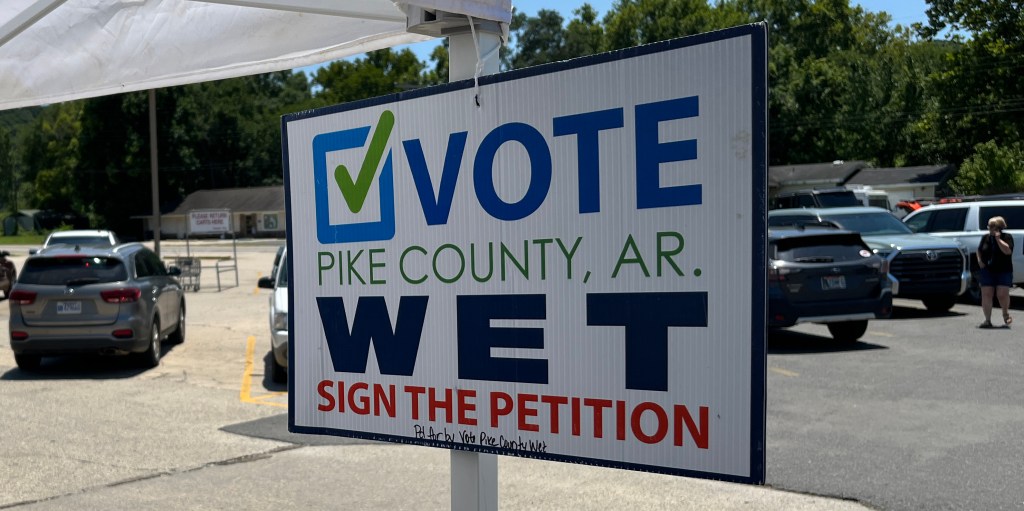
A campaign to again let Pike County voters decide whether to allow alcohol sales is facing a significant challenge in collecting enough signatures to place the question on the November ballot.
As of the end of the day Tuesday, July 21, 1,152 petition signatures had been collected, according to Jack Bonds, chairman of the local-option ballot question committee Vote Pike County Wet. That’s less than half of the 2,387 valid signatures required to qualify for the ballot.
However, with six paid canvassers working to close the gap before the Aug. 1 deadline, Bonds said he remains confident the campaign will get enough signatures to qualify.
“I think we’re going to get it,” he said.
Bonds said the campaign is in a similar position to where it was during the previous petition effort four years ago. Enough signatures were eventually collected in 2022 to put the question before voters, but the proposal failed by six votes.
“We’ve done this once before,” Bonds said. “Toward the end, a lot of people go, ‘Oh my goodness, I haven’t signed yet.’ You’d be surprised how many people show up and actually sign during the last week. It tends to get pretty intense.”
Bonds owns several businesses in Murfreesboro, including Chimney Rock Grocery, which could sell beer and wine if voters approve the proposal. Other grocery and convenience stores that could also sell beer and wine are also supporting the campaign.
One challenge now being confronted is that many people who signed a petition four years ago cannot be located.
“A lot of people have left the county,” he said. “People that signed last time aren’t here now. Either they’ve passed on or they’ve moved on.”
He said the current campaign has spent significantly less money than the previous petition effort because it is not relying on direct mailings. Bonds estimates that in 2022, the campaign spent $20,000 to $25,000 on direct mail. He said those efforts were not effective because many recipients did not return signed petitions.
“We haven’t spent half that this time, not near half that,” he said.
Instead, the campaign is paying canvassers to collect signatures, which Bonds said wasn’t done four years ago. He said additional people might be hired in the final days before the deadline to submit signatures for approval.
The entities that have made financial donations to support the campaign are not yet publicly known. Bonds said a required campaign finance report will be filed with the Arkansas Ethics Commission by the end of the month. The report is expected to identify donors and disclose the amount each contributed. At this point, the only filing available is the committee’s statement of organization, which was filed on March 25.
Bonds acknowledged that some residents oppose the proposal for religious reasons or because they have concerns about health impacts of alcohol, but said he believes the issue is primarily about economic development.
Bonds said he believes some residents incorrectly assume the county would be flooded with liquor stores if the measure passes. He said state law limits the number of liquor stores in a county based on its population.
“There’s a big misconception that we’re just going to be covered up with liquor stores,” Bonds said. “The county would literally have to double in size to have two liquor stores.”
He noted economic challenges facing the area, including the recent closure of the Hope Baking Company facility in Nashville that eliminated about 250 jobs.
“We’re after jobs,” Bonds said. “This is about bringing jobs to Pike County.”
He said tourism is an important part of the county’s economy and noted the campaign cites research indicating about 65% of tourists consume alcohol while on vacation.
“It’s very bewildering to tourists that come here,” he said. “They’ve never even heard of a dry county.”
That sends visitors to places where alcohol is legal, such as Hot Springs, diverting potential tax revenue away from Pike County, Bonds said.
RELATED STORIES: