An effort to again have voters consider a proposal to allow alcohol sales in Pike County did not secure enough petition signatures to be placed on the November ballot.
Jack Bonds, chairman of the local-option ballot question committee Vote Pike County Wet, said in an interview Tuesday, Aug. 4, that about 1,400 signatures had been collected. The campaign needed 2,387 valid signatures from registered voters by the Aug. 1 deadline.
Four years ago, Bonds led a similar effort that gathered enough signatures to appear on the ballot, but the proposal was defeated by just six votes.
While he identified several factors that made this year’s effort more challenging, Bonds said he was still surprised by the low number of signatures collected.
“We got tons of support — it’s weird,” he said.
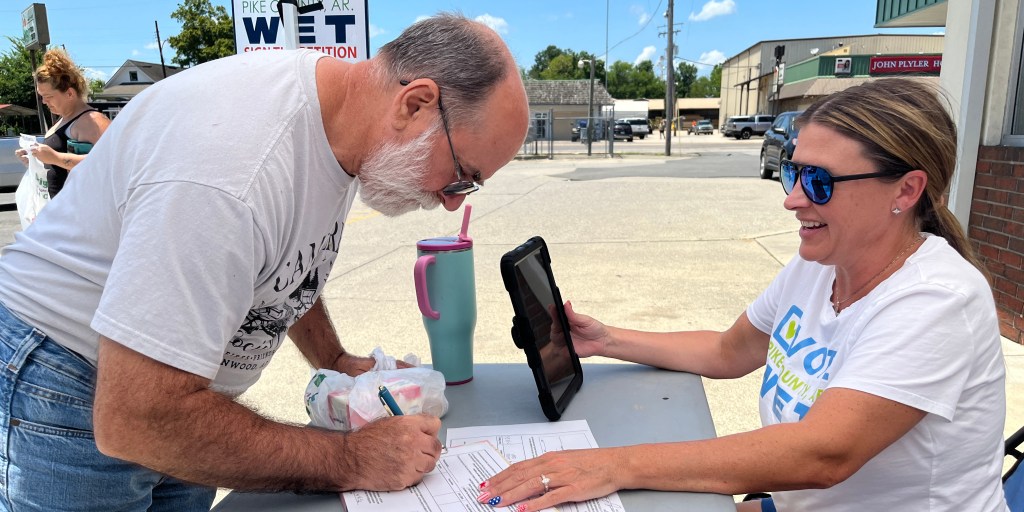
The campaign mostly relied on volunteers stationed outside grocery stores, convenience stores and other businesses in Glenwood and Murfreesboro to gather signatures. Petitions were also left at some businesses for people to sign. In the final couple of weeks, when it became apparent the campaign was not on track to meet the required number, it began paying six canvassers, Bonds said.
“We do wanna thank everyone that worked so diligently and worked very hard to get it done. The truth is, we just need more people to work on it,” Bonds said.
Some canvassers went door to door, which he said was extremely time-consuming.
“You can figure it takes about 15 minutes per petition [signature], so if you spend eight hours, you’re gonna get about 30 to 32 signatures, somewhere in that ballpark.”
A key challenge Bonds pointed to was Pike County’s declining population. U.S. Census Bureau figures show the county’s population fell about 10% between the 2010 and 2020 censuses. A July 2025 estimate put the population at 9,964, another decline of about 2%.
Bonds said the campaign looked at who had signed petitions four years ago, but many of those people could no longer be found.
“A lot of people have left the county,” he said, “either passed on or have moved on. It’s a huge population loss, and going back and trying to retrack our steps from last time, it was kind of sad — those people are just gone now, they don’t exist. I would anticipate the same problem in the future if we don’t turn around the population decline.”
Asked whether there will be another effort in future years to make Pike County wet, Bonds said the group has not discussed it.
“We haven’t even talked about that, not our core group. We’ve been working so hard on this one and frankly, it’s a disappointment. Today wouldn’t be the day to talk about it.”
Many community leaders who privately supported the proposal because of the sales tax revenue it could generate were hesitant to publicly advocate for it. There was also an expectation among supporters that, given how close the 2022 election was, the proposal would pass this time.
While there was no visible organized opposition to this year’s proposal, canvassers said the mood while collecting signatures was different compared with four years ago. Some people became argumentative when approached about signing a petition. The rhetoric also became heated at times on social media.
Pastor David Lamb of Bethsaida Church of Christ near Amity said in an interview that he hopes there won’t be another effort to allow alcohol sales in future years.
“Maybe they’ll leave this thing alone — they should. They’ve spent a lot of money, a lot more this time than last time,” Lamb said. “It’s just not going to go in Pike County.”
As of Wednesday, Aug. 5, the committee backing the proposal had not filed a financial report with the Arkansas Ethics Commission, so it was unclear how much money had been raised or spent. Its only filing this year was a statement of organization in March listing the committee’s three officers: Bonds, Secretary Lisa Harvill and Treasurer James Terrell, all of Murfreesboro.
In 2022, the previous committee, which had two of the same three officers, filed reports nearly every month. Bonds said a report by the current committee will be filed as required.
The committee backing the proposal “got a lot of support from outside the county,” Bonds said.
“That’s not a petition [signature], but it is someone hoping we could do something here and it would be great for them to come spend their money in the county, there’s no doubt about that.”
Tourism related to the Caddo River has become a growing sector of Glenwood’s economy, with people from outside the area purchasing property in the city. A group of about two dozen cabins known as Caddo River Row, ranging from one to six bedrooms, has been built in recent years to provide nightly accommodations. The cabins are primarily owned by investors from Texarkana.
One argument made by supporters of the proposal was that allowing alcohol sales would keep tourists from traveling to nearby places such as Hot Springs to buy alcohol or seek entertainment. Supporters also hoped becoming a wet county would help attract new restaurants to Glenwood because alcohol sales can provide restaurants with higher profit margins.
RELATED STORIES: